
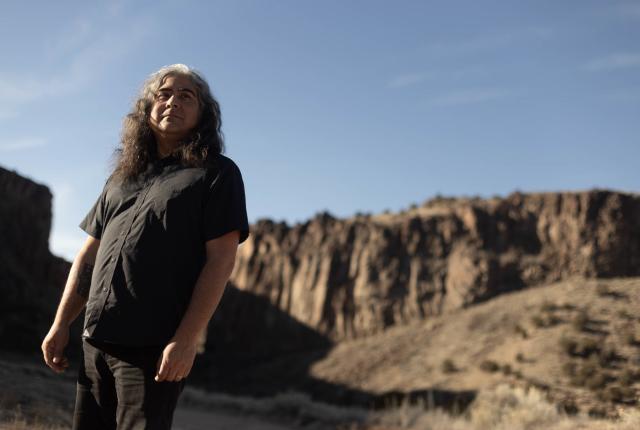
c Minesh Bacrania
One of the options for the premiere of Voiceless Mass was Present Music’s annual Thanksgiving concert, but Chacon was initially reluctant to commemorate such an occasion. “As an Indigenous artist, I make a point not to present my work on this holiday, but in this case I made an exception.” Several factors persuaded Chacon to proceed, including the prospect of writing music for a pipe organ, a magnificent instrument housed in a highly resonant space built for sacred community gatherings. The commission also offered Chacon a valuable opportunity to address critical issues concerning the legacy of the Catholic Church and the atrocities committed against Indigenous peoples — particularly the residential schools, forced assimilation, and abuse of Indigenous youth — and Chacon was eager to evoke this history directly within the walls of the sanctified institution. “This work,” he writes, “considers the spaces in which we gather, the history of access of these spaces, and the land upon which these buildings sit.” Though the title refers to a “Mass,” the liturgical rite and choral genre common to many Christian denominations, there are no vocal parts and no audible singing. “In exploiting the architecture of the cathedral,” Chacon explains, “Voiceless Mass considers the futility of giving voice to the voiceless, when ceding space is never an option for those in power.
The placement of performers within the space is a crucial aspect of Voiceless Mass. The score asks instrumentalists to surround the audience, while only the conductor and organist remain on stage. This staging choice is symbolic: The conductor assumes the role of a priest or officiant, while the organist, whose instrument historically replaced choir members, embodies the pervasive presence of the church. The organ mostly blends with the fragmented ensemble as an underlying drone until the middle of the work, when a distorted chorale surfaces as a dominant force. The surrounding instrumentalists are individually positioned throughout the church, simultaneously representing and enacting displaced and marginalized voices. They each play fragmented passages within restricted sets of intervals, emerging and submerging as fleeting apparitions. Instructions in the score highlight themes of compelled silence, lost language, and forgotten culture: The violist plays a note only they can hear, the clarinetist alters the timbre by shaping their mouth into different vowels, the flutist faintly recalls material from earlier in the piece, and the percussionist mutters under their breath. The integration of electronic sound reinforces the resonance of the space and underscores the insidious connection between authority and permanence. “As an electronic counterpart to the tones of the organ, the sine tone is implying that the church is going to last forever,” he says. “It’s so subtle that sometimes you can’t tell if you’re hearing the highest key on the organ or a 7000-Hz sine tone.” By navigating the intersection of sound, silence, and power, Voiceless Mass invites listeners to bear witness not only to what can be heard, but more importantly to what is being silenced, offering a powerful testimony on the enduring injustices of colonialism. Upon awarding Chacon with the Pulitzer Prize for Music in 2022, the committee called Voiceless Mass a “mesmerizing, original work… that evokes the weight of history in a church setting, a concentrated and powerful music expression with a haunting, visceral impact.
— Eric Smigel