Listening in many languages
on ‘Laughter Studies’
Seppe Decubber
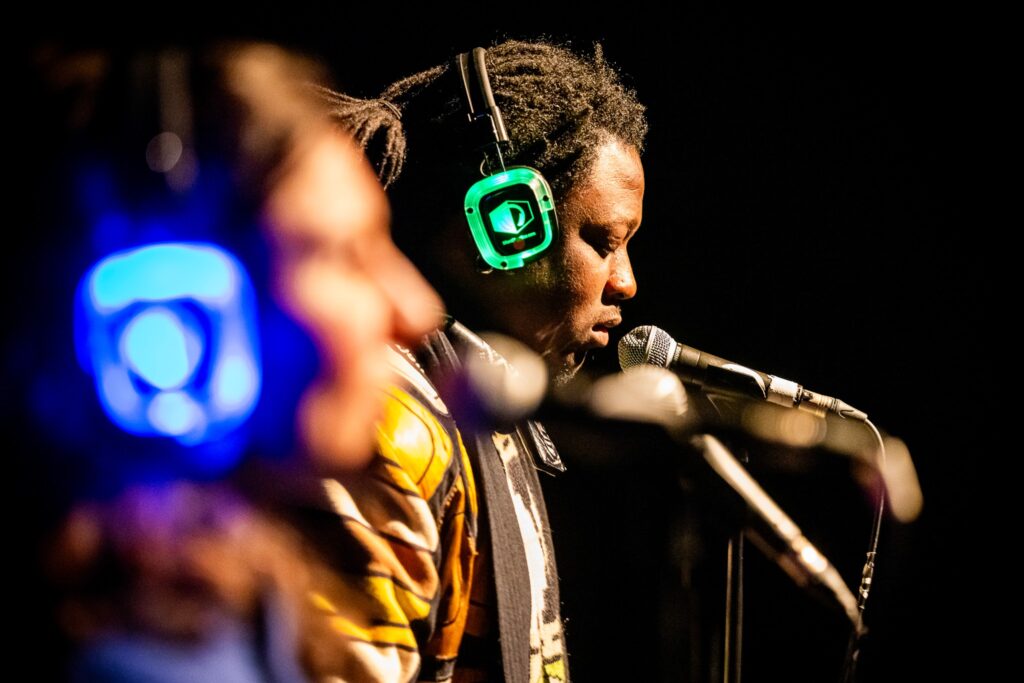
During the spring half-term holidays of 2026, I attended the rehearsals for the production ‘Laughter Studies’ by Nadar Ensemble & Fameus. ‘Laughter Studies’ is a reworking of the 2017 piece of the same name, and characteristic of the way in which Nadar has been exploring and presenting contemporary music since its foundation in 2006: driven by a desire to free contemporary music from its straitjacket, and to share it with an audience that might not naturally find its way to it. In the past, for instance, the Nadar musicians have brought compositions featuring balloon pilots or crane operators to the stage, or interpreted sign language as conductor’s cues. To create even more space for experimentation, and for sharing that experimentation, Nadar founded the Summer School. A Summer School for young musicians. Louis D’Heudières – the composer and director of Laughter Studies from 2017 and of the 2026 reworking – attended the Summer Academy and thus came into contact with the company.
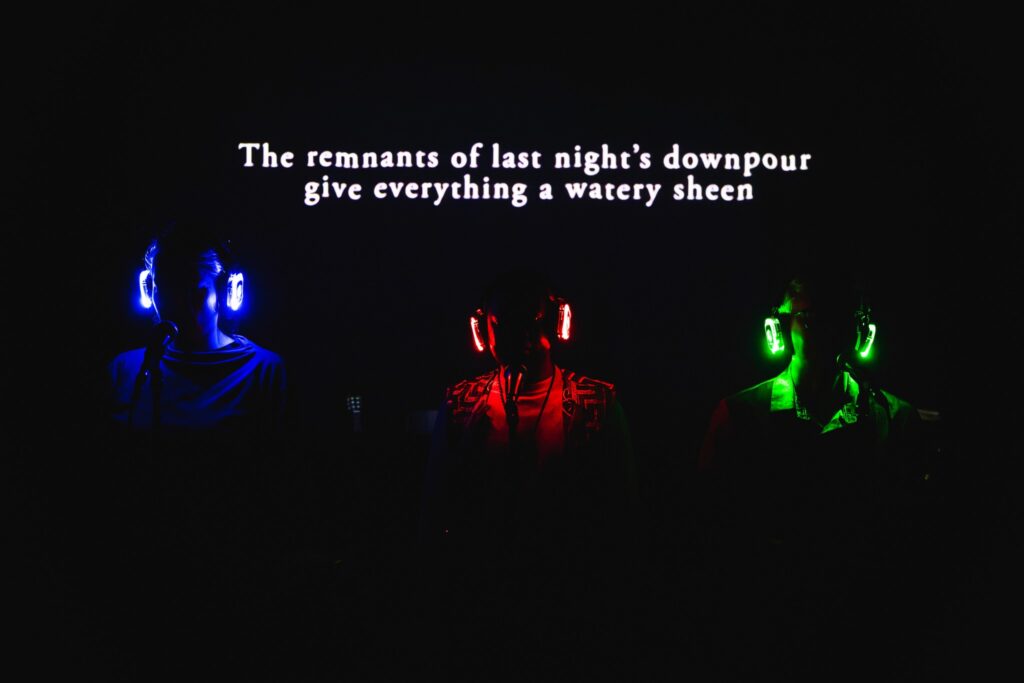
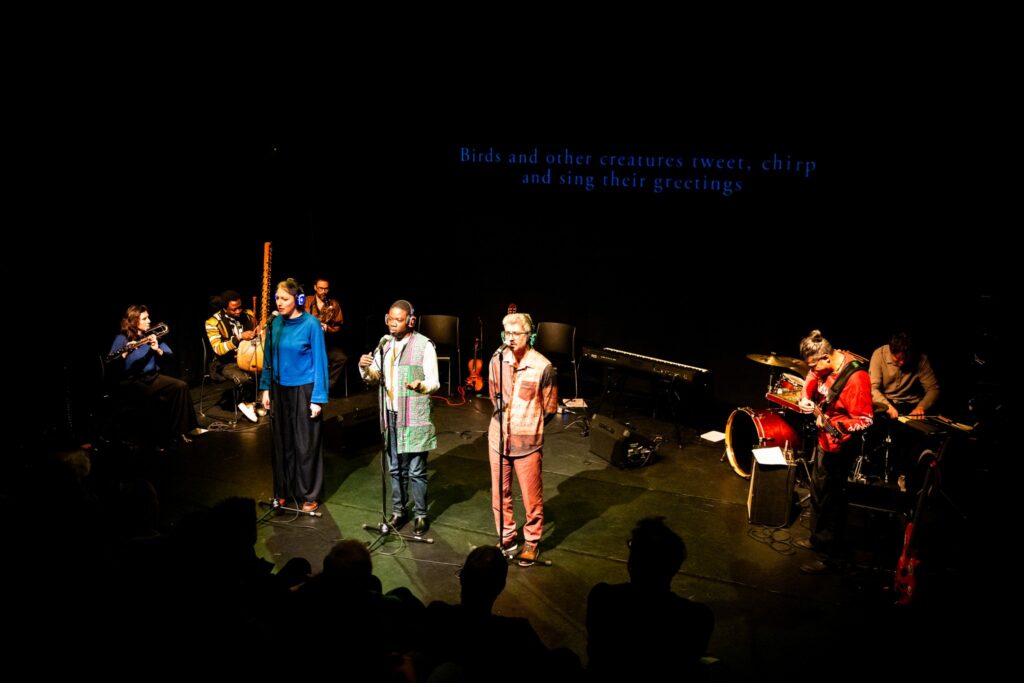
In ‘Laughter Studies’, live music alternates with performers describing and imitating sound recordings (inaudible to the audience). In addition, descriptions of sounds appear in surtitles. As a spectator and listener, you spontaneously begin to hear the musicality of spoken language, and echoes of speaking voices and the recordings resound in the music. Are you now listening to the meaning of words, or to their sound? And do you hear a sound because it actually resounds, or because it resounds in a performer’s words, or because a description evokes it? As I watched and listened, I thought of what Pauline Oliveros describes in ‘Quantum Listening’ as ‘the listening effect’ – the unexpected and quasi-magical effect that listening can have on a space. ‘As you listen, the particles of sound decide to be heard. Listening affects what is sounding. As you listen, the environment is enlivened.’ The American composer also describes how our eardrums make no distinction between false and real, and respond to the sounds from our dreams. ‘Laughter Studies’ offered a similar immersion in language, sound and music, and in the possibilities of language, sound and music where their presence remains enigmatic. At the end, two performers on stage describe the sounds they hear in the auditorium, and consequently the sound of the description being spoken by the other performer at that moment. Sound and description interlock at that moment, sound and word, in a loop that could go on forever.
Expanding the definition of what music is, and thus what listening is, is central to Nadar’s quest.
However, the specific emphasis of ‘Laughter Studies’ on language, on multilingualism and on the sonic experience of that multilingualism led the team to revisit this composition with four newcomers from Fameus and in the presence of a Fameus staff member. This collaboration was supported by supra-local grants.
Nadar’s four musicians – familiar with one another and each other’s artistic languages – were thus joined by four musicians who did not know one another, each bringing different approaches to music.
During rehearsals, Louis D’Heudières challenged the performers to sharpen the ‘listening effect’. What makes listening energetic or lively? When is listening too concentrated? How can a musical texture grow out of the attention everyone pays to one another? I noticed that the musicians did not make eye contact when they were listening intently, but looked at each other’s fingers or feet. (I caught myself staring at their fingers too, or tapping my foot to the rhythm in my seat.) Sometimes they strummed along with each other in silence. ‘I don’t understand you,’ I heard one musician say to a fellow player with a laugh, ‘your rhythm feels like a hallucination!’ Or, later, ‘I can’t find myself anywhere in that rhythm!’
In addition, the group also sought a language to describe sounds. What is the sound of walking on fresh snow? How do you describe the slow peeling away of a face mask? What words do you use for sounds in which several things seem to be happening at once? Describing the recordings turned everyone into a translator. I noticed that every performer, in their search for the right words in their mother tongue, was also unconsciously imitating the sound. Their voices grew louder or softer depending on the recording they were describing, their pace more erratic or more constant. The performers usually stared at the ceiling during this exercise, or at each other’s mouths. With their hands, they seemed to be kneading the substance of the sound in the air, as if their fingertips were dreaming the sound.
The group also had to search for a new language, both on and off stage, in order to play together and to steer that interplay in the right direction. It is a quest that never ends and gives rise to further exploration in future projects.
KREDIETEN
Flo Creten, Stadscanvas staff member
Katrien Gaelens, flute
Yves Goemaere, percussion
Wannes Gonnissen, sound
Robin Goossens Verburgh, business manager
Jafar Hamin, violin
Pieter Matthynssens, artistic director
Elisa Medinilla, keyboard
Giulio Napoletano, bass guitar
Kaspy Ndia, guitar
Issa Ndour, kora
Bertel Schollaert, saxophone
Veerle Vervoort, production
Production: Nadar Ensemble in collaboration with Fameus, Stadscanvas