September 26, 1864. As part of Les Fêtes de Septembre, the annual celebrations commemorating the Belgian Revolution, Gaspard-Félix Tournachon, also known as NADAR, launched his balloon, Le Géant, in the Botanical Garden in Brussels. None other than the official Photographe du Roi—also known as the Director of Public Entertainment—Louis Ghémar took a magnificent photograph of this spectacle. And what a crowd-pleaser it turned out to be. Thousands of spectators didn’t want to miss this unique event, and the crowd had to be kept at a distance using fences. These later became known colloquially as “Barrières Nadar”—or Nadar fences. The real Nadar, of course, could not help but protest and wrote a letter to the newspaper Le Petit Bleu du Matin in 1900 to express his indignation. After all, it is particularly ironic that Nadar—who had fought against any form of restriction his entire life—would have his name associated with a crowd barrier. After all, Nadar wanted to fly his balloon beyond the nation’s borders.
Countless prominent scientists, artists, politicians, and others could not escape the lens of Nadar, the artistic jack-of-all-trades who made the invisible visible. After all, Nadar took the first aerial photographs from his balloon, but he also ventured into the catacombs to give Parisians a glimpse of these underground cemeteries. It is Gaspard-Félix Tournachon’s adventurous spirit, his fascination with new technology, and his relentless energy that we want to share with our ensemble. So we don’t think twice about creating a composition featuring hot-air balloons, game controllers, or cranes. And who hasn’t secretly dreamed of hanging eight lampposts in the Red Hall? Cléo de
Sint-Niklaas
Studio Nadar, 35 Boulevard des Capucines The city of Sint-Niklaas is inextricably linked to the history of our ensemble. In the early years, rehearsals invariably took place at the music academy; later, the Duymelinck family warmly welcomed us to their textile dyeing factory, Colortex. The CC (now SN!K) gave us the confidence to fully commit to alternative concert programs, allowing us to gradually develop our artistic profile.
WARP, a platform for contemporary visual arts, was also a natural partner for presenting composers and welcomed students from our Summer Academy. During the arts festival De Nacht, we’ve consistently collaborated with d’Academie Podium en Beeld, and for 16 years in a row, we’ve organized our Summer Academy—in collaboration with Matrix New Music Centre—in our hometown.
In the balloon capital, it was only a matter of time before this happened. Together with the Sax-Rosseneu family, we created a full-scale production for four hot-air balloons and an ensemble, which was later even seen and heard at the Darmstadt Ferienkurse für Neue Musik. We’re still enthusiastically making plans with SN!K. And yes, balloons and musicians are made for each other: we’re dreaming of a heavenly soundscape in 2030.
“To me, they are beautiful and magical beings that live imaginary second lives when the work day ends.”
– Natacha Diels, composer
In 2018, two SpaceX Falcon Heavy rockets landed on the ground at exactly the same moment. Because of this simultaneity, we forgot their original mission for a few seconds, and they transformed before our eyes into two graceful dancers. American composer Natacha Diels (whose father is Belgian) is fascinated by cranes. As symbols of a city’s economic activity and progress, these cranes take on a life of their own in her world, becoming living characters capable of performing a choreography in counterpoint to the music. Lifting heavy loads and working against the clock are exchanged for an elegant dance and the unfolding of a butterfly—created entirely from recycled materials especially for this occasion by the young talents of STORMKOP and Kras Jeugdwerk, led by Fatima Shamizada.
Thanks to the collaboration between Nadar, DE SINGEL, two youth organizations, and the crane company Anthony Cranes, “Papillon and the Dancing Cranes” can be seen as an ode to the city on the Scheldt.
DE SINGEL : by Hendrik Storme, General and Artistic Director DE SINGEL
“The Nadar Ensemble has been part of my life for twenty years: first as a curious spectator, later as a programmer. My fondest memory is ‘Night of the Unexpected’ during the Klara Festival in March 2019, which we organized together at the Citroën garage Kanal—which hadn’t yet been renovated at the time. More than 1,000 visitors moved from concert to concert: Stefan Prins’ Piano Hero, Mátyás Wettl’s Nocturne for 16 Light Switches, Khubeev’s Ghost of Dystopia, and Kourliandski’s Emergency Survival Guide for Two Automobiles and Orchestra—cult classics that have since become part of the ensemble’s DNA. Equally unforgettable was September 2021, when three dancing cranes, an ensemble, and a giant butterfly jointly performed Natacha Diels’ Papillon and the Dancing Cranes in Antwerp’s public spaces during DE SINGEL’s Dear Antwerp festival. Admit it: what other ensemble makes cranes dance, puts cars on stage, or disappears into a black box? Congratulations on your 20th anniversary, and keep doing crazy things for another 20 years, both at DE SINGEL and far beyond!”
In HERMETIKA IX “Vox Angeli II,” commissioned by Concertgebouw Brugge, Bernhard Lang places the woman at the center. Her sung words are drawn from the Nag Hammadi Texts, a collection of apocryphal biblical texts discovered in 1945 at an ancient cemetery near the Egyptian village of Nag Hammadi. A striking feature of such early Christian writings is the duality between the divine and the earthly—a tension that has long intrigued Lang.
Under the title “HERMETIKA,” he created a series of compositions, initially for choirs (Hermetika I–III) and later for voice with instruments (Hermetika IV–IX). It comes as no surprise that the human voice plays such an important role in the series. It is no coincidence that liturgical texts are often sung. In spiritual and philosophical beliefs, the voice is often seen as a gateway to the soul, and singing enhances the spiritual and contemplative experience.
“Hide To Show is a full-length composition that, like most of my pieces, explores the boundaries between concert, music theatre, and performance. In the case of Hide To Show, though, it really pushes those boundaries to the extreme. The musicians don’t just play their instruments: they sing, they dance, they perform, and they were genuinely part of the creative process itself. That was what made this piece so special.
As a composer, you almost never get the chance to work on something over a longer rehearsal period, really living inside it. And I’m so incredibly happy that Nadar Ensemble made this long-held dream of mine come true. We had the wonderful opportunity to develop this piece together – conceptually, technically, musically – over an extended stretch of time, as a real collaboration. And that process is still going, from performance to performance.
At the heart of the composition is the question of how we relate to the peculiar situations we find ourselves in, as musicians, for instance, when we present ourselves online. But Hide To Show doesn’t take a critical stance on social media. It’s more about looking, in an extreme way, at what actually happens when you’re alone while communicating musically with others and that it can feel strange when you’re actually sitting next to someone. That you can protect yourself behind an avatar. That you can also cheat through one.
When the piece was ready for its first rehearsals in 2020, we had one session, and then the Covid lockdown hit. We found ourselves in a situation where isolation itself and its effects on the human psyche and on how we live together had moved to the very center of everyone’s attention. What a strange coincidence.”
“Laughter Studies is a piece that keeps evolving. Originally conceived for Nadar as part of the Summer School for Composers and Sound Artists in 2017, it evokes the kinds of sounds and behaviours made by an audience as it sits in a concert hall, waits for musicians to enter the stage, and applauds. This is done by describing and imitating the recorded sounds of another audience, in a different concert hall, at a different time, and by asking the performers to react in real time to what is happening inside this concert hall, with this audience, right now. (Like Cage’s iconic 4’33”, improved with live commentary).
Since listening, describing, and vocally imitating are activities which transcend musical training, they extend naturally to the musicians of Fameus, whose diverse range of cultural backgrounds bring an added richness to the piece. Here, the game is played not just by members familiar to the codes of contemporary classical music, but by members of a group who each bring a unique perspective to the experience of listening. The same thing happens to the music in the piece, its style and character undergoing radical transformations with each new performance. In the end, Laughter Studies is like an open-ended dialogue, into which different musics, languages, personalities, and ideas can be thrown and allowed to reverberate.”
In Voiceless Mass, American composer and Pulitzer Prize winner Raven Chacon explores the relationship between music, space, and power. In a church setting, he positions the musicians around the audience, with only the conductor standing at the front. By designing this arrangement, Chacon ensures that the listener is literally part of the work. The organ initially provides an almost inaudible undercurrent. Fragmented sounds emerge around it: voices that appear and disappear again, sometimes so soft that they are barely audible. Silence, distortion, and electronic sounds become just as important as the music itself. Chacon refers to the history of the Catholic Church and the violence against indigenous communities, but also to what is silenced or erased. Thus, Voiceless Mass becomes a poignant musical reflection on silence, memory, and power—on who is heard and who is not.
In 1969, the Russian poet Joseph Brodsky wrote a poem that would become known by its opening line, Don’t leave the room. In six quatrains, he urges the reader to stay indoors at all costs. After all, why would anyone leave the house when they have four walls, a bed, and plenty of cigarettes at their disposal? Opinions are divided on the meaning of Brodsky’s words. Is it an ode to voluntary seclusion, a call for self-censorship, or an ironic warning to friends to stay away from the KGB? Or does it, on the contrary, contain a hidden call to break the silence and resist oppression?
In this interdisciplinary concert, all these meanings converge, and new, contemporary layers are added. In *Don’t Leave the Room* and *Silentium!*, Alexander Khubeev explores the psychological and political mechanisms of censorship and self-censorship, using sign language as a deafeningly silent metaphor. In *Bluer Womb*, Golnaz Shariatzadeh creates an imaginary space where memory and mourning for the 2022 Iranian uprising converge with renewed hope for the future—a quest for refuge in times of political repression that is as personal as it is universal. In self-imposed isolation, Galina Oestvolskaya worked on an uncompromising and incomparable body of work.
In her piano sonatas, the pianist pounds—not plays—a barrage of clusters onto her instrument with a flat hand and forearm, creating music that would never have passed Soviet censorship. In the beautiful short film *The Chorus*, Iranian filmmaker Abbas Kiarostami sketches a fable about silence and sound, old age and youth, isolation and connection. A poetic plea not to shut yourself off from the world, but to keep listening to the voices that need to be heard.
“I grew up with my mother in a tiny apartment; each family had only one room. The kitchen was shared, as was the hallway. I remember that whenever you had to use the bathroom, you had to do it as quickly as possible because there was always someone waiting behind you. You also had to be as quiet as possible in your room—the walls had ears. You were literally locked up between four walls. To me, Brodsky’s text feels like a prison—but also like a form of protection. It says: stay inside, be silent, don’t speak. That’s censorship, but it’s also survival.”
“When I read the poem, I feel like I want to say something but can’t—or am not allowed to. I can’t get it out. That’s my experience as a deaf performer: there’s always a gap between what I read, what I feel, and what I can express. The taboo, the censorship—it’s embedded in the language itself. That’s why this poem touched me so deeply.”
– Elena Evstratova, performer
NADAR SUMMER ACADEMY
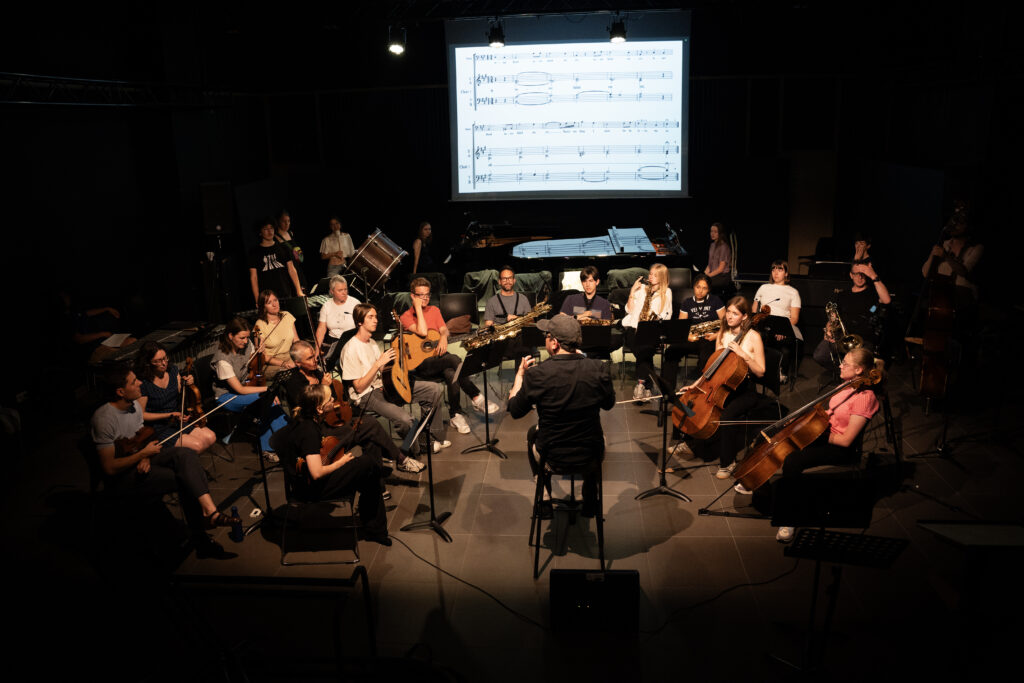
Every year, at the start of summer vacation, Nadar sets out with a group of teenagers. By bike, with a stack of new music in their bags—and a bit of trepidation in their hearts. Because how will teenagers react when we sit them down at a piano dressed in surgical scrubs? What if we ask them to rehearse a rhythmically tight part on an imaginary violin? What if we have them decipher a piece by Stefan Prins, or even just present them with a blank score? Will the spark really fly between us—now in our forties—and that open-minded, completely honest young camp audience?
It feels like an exciting exam every single time—or should I say a blind date? (Because in hindsight, that sense of excitement turns out to be mutual.) The thrill and energy we get in return are truly unmatched.
Time and again, I’m surprised by what moves them. The honest, poetic—but at times also simply pragmatic—way they look at, listen to, and play with that avant-garde material brings me closer to the music myself.
In short: the Nadar Summer Academy is my annual retreat. An exciting, confrontational mirror for what we do, but above all a playground where new ideas come to life. Physically, we’re completely exhausted after a week like that, but we get tons of enthusiasm in return. So on the last evening by the campfire, we always feel a little young again; strengthened by the feeling that we were able to connect with one another, and that the Nadar saga is being picked up by the next generation, taken on, and reshaped into a new, thrilling project.
– Elisa Medinilla
NADAR SUMMER SCHOOL
Having passed the 35-year mark, our ensemble set out to find a new way to connect with the youngest generation of composers. Since 2017, we have been organizing the Nadar Summer School for Young Composers in collaboration with DE SINGEL. While we initially issued a call for applications ourselves and organized rehearsals and a concert within the confines of DE SINGEL, we quickly sought out partners to support this initiative.
Together with Transit Festival, Gaudeamus Festival, Warsaw Autumn, Huddersfield Contemporary Music Festival, and Contemporary Music Centre Ireland/New Music Dublin, we sought our own path within an overheated production landscape where the premiere all too often marks the end of the artistic process. In this way, we guarantee the composers immediate opportunities for multiple performances of their work. By taking them on tour, they can also expand their own international networks and continue to refine their compositions to elevate their work to a higher level.
Participants such as Louis d’Heudières, Golnaz Shariatzadeh, Kelley Sheehan, Piotr Peszat, … subsequently returned to participate in other Nadar programs.
TEAM
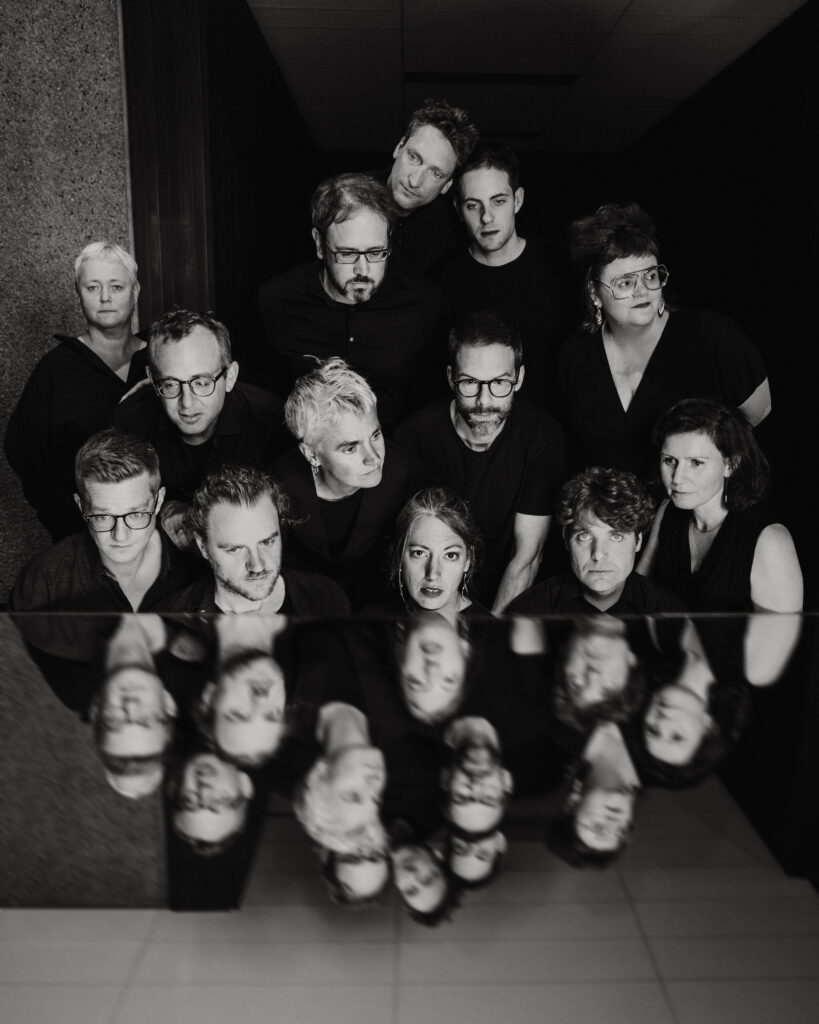
Bertel Schollaert, Saxophone£ Dries Tack, Clarinet Katrien Gaelens, Flute Pieter Matthynssens, Artistic Director, Cellist Veerle Vervoort, Production Manager Yves Gomaere, Percussion Nico Couck, Guitar Thomas Moore, Trombone Elisa Medinilla, Piano Mar Berendsen, Violin Robin Goossens, Business Director Wannes Gonnissen, Sound & Video Jasmien Witvrouwen, Graphic Design & Communication