Long before I came into contact with contemporary music, my first musical steps were mainly into the area of early music. The polyphonic language of the Renaissance and baroque periods, the unmistakable style and musical aesthetic or these ages especially in musical rhetoric and detailed articulation), hugely influenced my self-development. Even as a young instrumentalist got to know this particular articulation, and our task was to base our music-making on intelligibility or the sung text. I devoted a lot of attention to the gentle, subtle variations, and was expected to read between the lines. And so both my experience with vocal forms (with devotion to the small details) and the big affective gestures became basic elements of my musical world.
Only after many years as a composer, striking out onto new paths in the active search for a contemporary tonal language, did I dare to increasingly use these old’ forms to then reduce them to the conceptual point or departure or my work.
While preparing this piece, it soon became clear that my fascination with the
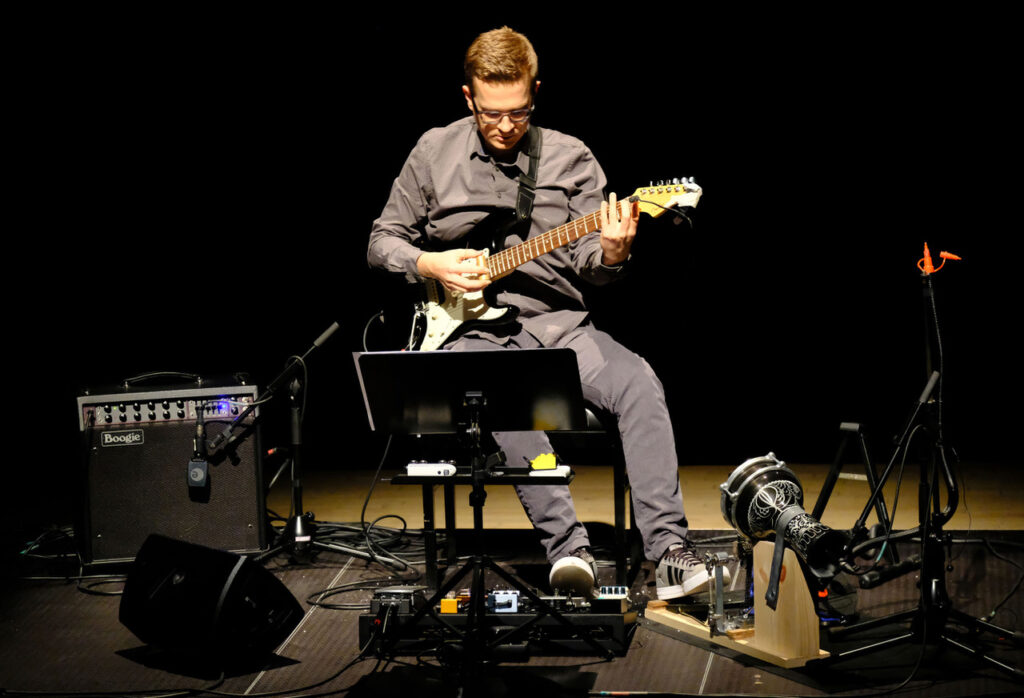
work of Johann Sebastian Bach – in particular his famous D minor partita for solo violin BWV 1004 – would be highly influential. Nico Couck was also extremely enthusiastic, not only is he knowledgeable about early music, but he had already played an arrangement of this piece for classical guitar.
Thus I developed a compositional process with its origins in Bach’s score, and in which I transformed his vocabulary into a present-day musical gesture. Both its many small-scale motifs and the overarching (and cyclically recurring) phrasing aesthetic were determining factors, and they are constantly present in the piece.
It’s similar to the way that, when you look out the window from inside a train, everything close by passes quickly and in a blur, while things in the distance take on a feeling of tranquillity, slowness and clarity. Based on the cyclic chaconne form, in which a harmonious ostinato is both the starting point and the reference point for many variations, The Wilderness of Mirrors also aims for the differentiated-variations form. Everything returns, but each time it reappears it’s in a new light and a new context. Motifs are explored, turned, stacked, unstacked and fragmented until they are no longer recognisable. The symbol of the mirror plays primary part several times: we look from different vantage points at the guitarist – and ultimately at ourselves, as if he himself is in a mirror frame. The mirror is the intersection and projection surface of various soundscapes and their historic relations: old versus new, analogue versus digital, live versus electronic. The interaction between earl music’ and the new sonic language is a kind of transition in which we focus our contemporary gaze on music history. Sonic events are simultaneously projected, spread, distorted, compressed, multiplied, reduced and enlarged in different directions, all at electronic level.
Increasingly we are losing ourselves in a world of facades in which we can no longer trust our senses. Bach’s musical vocabulary is thrown into the sound world of the electric guitar, like a cloudy mirror. and manifests itself in a sound aesthetic reminiscent of the work of David Lunch. At the same time, this sometimes-surrealistic mood is embedded in complex, diffuse and partially overloaded electronics consisting exclusively of guitar samples. We see outlines or shadows of the chaconne we knew, but their appearance becomes increasingly strange. Lastly, the train window reflects not only closeness and distance, but also our own reflection. The Wilderness of Mirrors feels connected to all these possible means or retraction.
— Eva Reiter —