
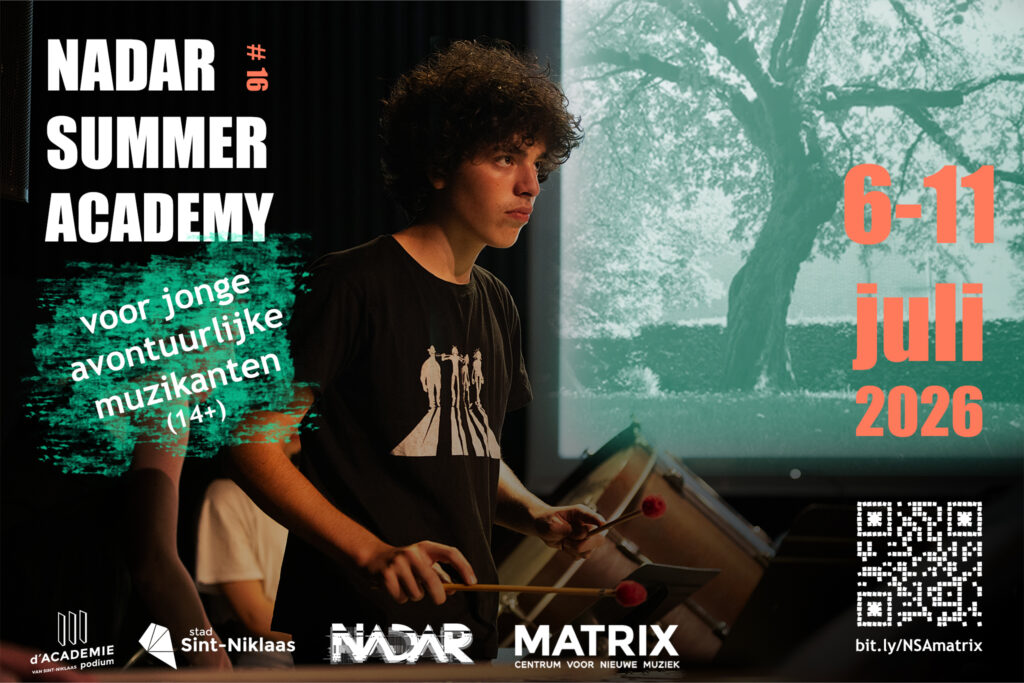
Every year since its first edition in 2011 Nadar and MATRIX [New Music Centre] organise a five-day summer course for adventurous performers and composers between 14 and 20 years old. With the members of Nadar as their passionate guides these young people are challenged to explore the exciting world of new music, playing and creating existing and new compositions. In 2015 the Nadar Summer Academy was nominated for a YEAH! Young EARopean Award in the category of ‘process’.
Subscribe or questions? Contact: melissa@matrix-new-music.be
Website Matrix
Previous Editions
“It was only at Nadar that the door to contemporary music really opened for me”
– on fifteen years of the Nadar Summer Academy –
On stage, three young musicians stand around a concert grand piano. The lid has been removed from the instrument: strings, hammer heads and dampers lie exposed in a bright spotlight. The trio are wearing face masks and hairnets. Their bodies are clad in yellow surgical gowns. Here, advanced timbre research is being conducted, and with surgical precision.
Look, there Sound Doctor 1 is making a coin disappear into the instrument’s interior, as if it were a scalpel. Immediately, metallic scraping sounds emerge from a bass string. Doctor 2 plays a thumb pick positioned on the soundboard of the grand piano. Spooky resonances envelop soft plucked tones. When Doctor 3 rubs a rubber mallet firmly across the wood of the soundboard, it becomes too much for the patient: the instrument begins to whimper and groan softly.
Crash course in new music
The concert grand piano as an acoustic surgical object. The idea sprang from the compositional mind of the Russian Elena Rykova, whose 101% Mind Uploading was rehearsed last year during the Nadar Summer Academy. It was no walk in the park (an understatement), but then it never really is during the youth workshop organised annually by the Nadar Ensemble and MATRIX [Centre for New Music] – this summer for the fifteenth time.
The format in a nutshell: for five days, a dozen young people (aged 14 to 20) receive an intensive crash course in new music under the guidance of experienced Nadar members. The base is the idyllic Hoeve Oswald, situated in a quiet area in the Waasland. From there, they cycle daily to the well-equipped Music Academy of Sint-Niklaas, where the latest compositions appear on the music stands. Often these are scores where the ink is barely dry, requiring experimental playing techniques, sophisticated electronics and complex media set-ups. If you want to get an idea, it’s best to have a look on YouTube. Search for ‘Stefan Prins, Generation Kill’ (on the programme in 2017) or ‘Michael Beil, Exit to Enter’ (scheduled for 2022). Many a conservatoire student would struggle with it.
And yet, at the Nadar Summer Academy, teenagers manage year after year to master that demanding repertoire within a week. Better still: to bring it to the stage in spectacular performances. Not only at the closing concert, but also in renowned venues such as De SINGEL, Concertgebouw Brugge, De Bijloke, or at festivals such as Transit and What’s Next.
Both feet firmly in society
What is the secret behind that success? ‘Vegetarian meals, yoga sessions and good conversations around the campfire,’ joke cellist and artistic director Pieter Matthynssens and pianist Elisa Medinilla. It is a Saturday afternoon in April. From the Nadar offices at DE SINGEL, where the ensemble is Resident Artist and will move into its own studio in 2024, the pair look back on the past fourteen editions.
Medinilla: ‘Of course, the work is hard and intensive, but the Academy is about more than just music. When you work with young people, it’s a complete package. You share the magical moments on stage, but also the stress and frustration when something doesn’t go to plan, or when someone isn’t feeling themselves. Every year, we try to create a homely atmosphere in which everyone feels accepted and supported. Only then can a close-knit group emerge, in which the participants bring out the best in one another.’
Matthynssens agrees: ‘It’s important that the participants can be themselves. That was once beautifully put by one of the young people. In the guestbook we keep, he wrote that he had never felt so at home anywhere before. Wonderful, isn’t it? We notice it in the parents too. During the final concert, they often stand there with tears in their eyes, because they can’t believe how their child has developed in just a few days.’
Then the follow-up question: Why did the Nadar Ensemble choose to embark on such a demanding educational programme in 2011, barely three years after its foundation?
Matthynssens: ‘When we started the Summer Academy, there was hardly anything in the field of education and new music. Contemporary repertoire? That was seen as difficult and specialist. Far too complex for amateur musicians, let alone for young people. We at Nadar stepped into that gap, precisely because new music so desperately needs that connection with younger generations.’
Don’t get me wrong, he qualifies: ‘Fantastic music is being written today, without a doubt. But still, as we played more often with Nadar in Darmstadt or Donaueschingen, I began to notice how exclusive that world is. Contemporary music is a niche, a very interesting one, admittedly, but a niche nonetheless. If we don’t consciously keep looking for ways to translate what happens there into today’s society, that music risks losing its urgency.’
Artistic background and pedagogical power
It was with this in mind that Matthynssens approached musicologist Rebecca Diependaele in late 2010, who was working for both Nadar and MATRIX at the time. ‘The idea of a summer course fitted seamlessly with MATRIX’s objectives,’ Diependaele explained via a video link in early May. ‘Namely, making new music accessible to a wider audience, partly by providing good education. In the Nadar Summer Academy, those two aspects came together very organically from the start. On the one hand, we could draw on the in-depth repertoire knowledge that was already present within the ensemble. On the other hand, many of the Nadar members already had considerable teaching experience under their belts, so the pedagogical side was also immediately well covered.’
Matthynssens and Diependaele agreed on a division of tasks whereby Nadar took care of the artistic and content-related aspects, whilst MATRIX provided organisational and financial support. It proved to be a golden formula, which immediately bore fruit. Take the second NSA edition in 2012, the year in which the ISCM World Music Days Festival came to Belgium. During Transit, the participants gave a concert in a packed Soetezaal, filled to the rafters with international music professionals. The programme included works by Varèse and Berio, as well as new works by Stefan Prins and Matthew Shlomowitz.
The reactions afterwards were effusive. As the now defunct music website Kwadratuur noted: ‘Hearing precisely that repertoire played by teenagers who perform it with the same natural ease with which their peers play Mozart sonatas or Adele’s Someone Like You is a unique experience.’
A unique position in a changing landscape
The Nadar Summer Academy has since established itself as a fixture in the field of music education. It has garnered praise both at home and abroad, including a nomination (2015) for the Young EARopean Award, a European prize for projects that inspire young people to engage with music beyond the beaten pop tracks.
At the same time, the landscape in which the Summer Academy operates has also changed. In the ‘youth engagement with new music’ category, several valuable initiatives have emerged in recent years. Wind ensemble I Solisti launched its own Academy and Summer School for young instrumentalists. The HERMESensemble started The Times, a forum for young composers.
Yet the NSA has managed to retain its distinctive position amidst these shifting dynamics, believes Nadar pianist Elisa Medinilla: ‘To be honest, I don’t know of any other initiative that does what we do. Certainly not in a format where young musicians and composers work together intensively for a whole week. Moreover, regardless of level or prior knowledge. Other projects often work with auditions or pre-selection, but for us, motivation, curiosity and an open attitude are the only requirements. If those are present, you actually always have the right people in the right place. We see that year after year.’
Another unique asset is the repertoire rehearsed during the NSA, adds Matthynssens. Certainly in recent years, this has often involved works by typical Nadar composers: alongside the aforementioned Stefan Prins (also co-artistic director of Nadar) and Michael Beil, there are also Alexander Schubert, Simon Steen-Andersen, Jennifer Walshe and Joanna Bailie. Matthynssens: ‘These are pieces that can really only be taught by us, simply because only we have the experience and technological know-how in-house. The NSA thus gives participants the chance to discover repertoire they would never encounter elsewhere. Not even at the conservatoire.’
From score to group concept
Has much changed in the Academy’s structure over the years? ‘Quite a bit,’ says Matthynssens. ‘Gradually, we’ve learnt that it works better to focus on the group as a whole. At the start, we were still very much guided by the score. Everyone was given an individual piece to learn, but that proved too much of a burden within a week. Stress levels sometimes ran high. Now we work from a shared concept, in which we try to give space to the individual qualities of the participants.’
He emphasises that the fact the ensemble knows the repertoire from the inside out helps with this. ‘We often know the composers personally, and understand the intention behind those scores. That familiarity creates space to reshape the underlying ideas together.’
Based on this freer approach, quite a few pieces from the Nadar catalogue have been ‘reinterpreted’ into an academy version in recent years. For instance, Stefan Prins’ Generation Kill gained an NSA offspring, Michael Beil’s Mach Sieben (originally for piano) was transformed into an ensemble version, and the audio walks by Canadian sound artist Janet Cardiff provided the inspiration for a summer audio-video walk through Sint-Niklaas.
The activities surrounding the working sessions also became freer and more group-oriented, says Medinilla: ‘In the early years, we kept a tight rein on things. We put together a whole programme with lectures, mini-concerts by the various ensemble members and musical quiz nights. But we soon realised that the participants themselves were brimming with good ideas. There have been editions in which new ensembles emerged, or work continued late into the night on a chamber opera.’
A hair-pulling moment
Seen in this light, it is no coincidence that quite a few NSA participants made the leap to the professional music scene. A small selection: cellist Karin Broeckhove Ibarra went on to study at the Antwerp Conservatory and, in 2022, won the Klara Festival’s Supernova competition with the Firgun Ensemble. Or take composer-violinist Elisabeth Klinck, who founded the Nemø Ensemble for experimental music together with percussionist Wim Pelgrims. This spring, she gave a preview of her second album during the Rewire Festival in The Hague.
And then there are pianist and clarinettist Taha and Yassine Posman, who in 2019 were the driving forces behind the aforementioned chamber opera, Botrytis, which at the time formed the finale of the ninth edition of the Summer Academy. Since 2022, the Ghent-based brothers have been joining forces with cellist Jacob van Durme in Trio Malatya. With success: in the spring of 2023, the trio won both the BLM Competition (De Bijloke) and the Storioni Competition in Eindhoven. A few months later, the three travelled to Germany to work with the renowned sound researcher Helmut Lachenmann on his trio Allegro Sostenuto.
‘We were actually only due to meet Lachenmann months later during the Research Days at the Brussels Conservatoire,’ says Yassine Posman via video link in early June. ‘But then we suddenly received an email. Would we like to come to Stuttgart earlier to work on the piece with him?’
A ‘what-on-earth’ moment, Posman recalls: ‘We’d only prepared half the score, and it’s certainly not the sort of music you can just sight-read. What’s more, Jacob, our cellist, had very little experience with new music. That’s when I thought back to the Summer Academy, purely because we were faced with such challenges there every year. Without that experience, we probably wouldn’t have had the courage to say yes.’
In any case, the Nadar Summer Academy has left a lasting mark on his musical practice, according to Posman: ‘I used to have a wonderful clarinet teacher, but I mainly played classical repertoire. The door to contemporary music only opened for me at Nadar. That has been of great importance. Without that step, I wouldn’t be where I am now in my career.’